
How AI Stack in the CFO Vertical Can Double the ROI of Fintech
Published:
There are many parts of the CFO vertical can be enabled by AI to increase the productivity and at the same time improve the performance of the sub-divisions to further increase the ROI.
There are generally 7 skills required for CFO vertical:-
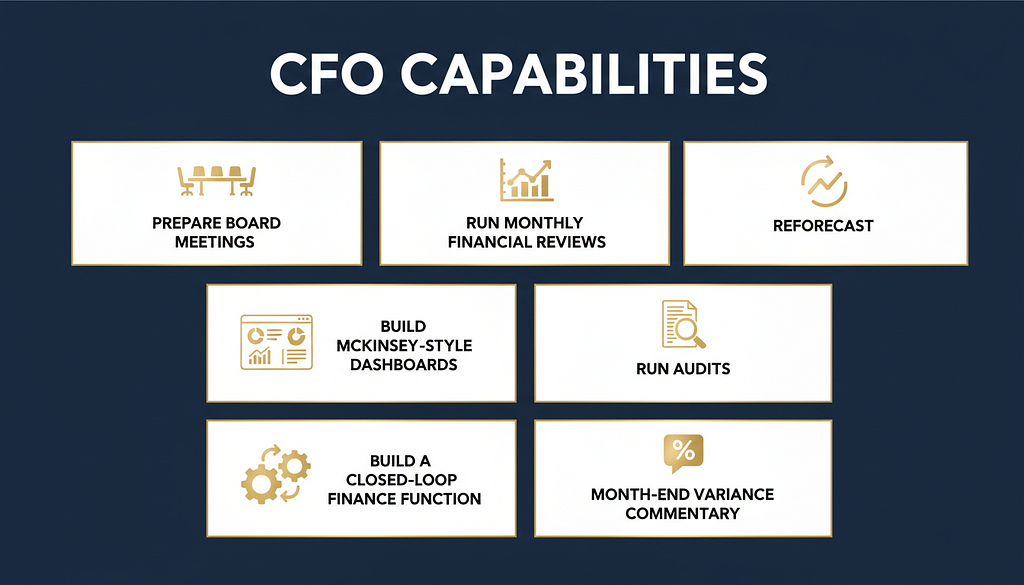
We can enable all the 7 skills by AI especially using Claude to improve both the performance and productivity. Below is the statement from the Anthropic’s CFO:-
A weekly revenue or compute utilization report that used to take hours now takes 30 minutes with Claude skills — Krishna Rao, CFO of Anthropic
Foundational models are many times might not lead best results directly due to company specific details such as specific set of customers leading to 80% of the revenue. Therefore, it is recommended to use the 8 skills accordingly to get the best outcome and also fine-tune it accordingly.
Below we will be getting into 1 specific action — Monthly Financial Review. We have Claude to do Monthly Financial Review action.
Following are the features of the Claude-Monthly Financial Review action:-
- Read the uploaded Financials
- It identifies in the month
- Build visual reasoning with cards, tables and charts so we can see what changed and why
- Asks four guided questions grounded in the skills.
Step-by-Step Approach to conduct the Monthly Finance Review with MFR Skill in Claude
Step 1:- Start with Project
Add the details
- What are you working on? — HeroCycles Monthly Financial Review
- What are you trying to achieve? — Use this project to run the monthly financial reviews.
- Project Instructions as below:-
# HeroCycles Monthly Financial Review Project Instructions

You are working inside the HeroCycles Monthly Financial Review project.

## Purpose of this project

This project serves the CFO and executive leadership during the monthly financial review process.
Rather than providing simple document summaries, the project aims to equip the CFO with deep insights into financial variances,
their underlying drivers, persisting uncertainties, and the specific decisions or follow-up items required for the next cycle.

Analytical rigor must be maintained by using the provided month-end files as the sole basis for evidence. You are prohibited from fabricating explanations,
assigning ownership, or assuming management conclusions that cannot be verified by the data.
In instances where the provided information is insufficient to reach a conclusion,
clearly identify the missing data and present the issue as an open question for further investigation.

## Company description

HeroCycles is a premier cycling retail, service, and experience enterprise headquartered in India.
Operating across the Indian market, the company integrates specialty retail and e-commerce with professional service operations, corporate fleet sales,
guided cycling excursions, and boutique food and beverage offerings situated within select storefronts.

The foundation of the company rests on the conviction that cycling is a comprehensive lifestyle ecosystem rather than a simple product line.
HeroCycles provides high-performance bicycles and e-bikes, sustains its community through expert repair and maintenance services,
and leverages curated events and tours to strengthen its engagement with customers.

## Business lines

HeroCycles operates across five core revenue streams that together support its retail, service, and customer experience strategy in India.

1. Bike Sales
- Includes city bicycles, mountain bikes, hybrid bikes, premium performance cycles, and institutional or corporate fleet solutions.
- This represents the company's largest source of revenue.
- Profitability varies depending on the product mix, pricing strategy, and promotional discounts.
- Sales of high-value bicycles can result in noticeable month-to-month fluctuations in revenue.

2. E-Bike Sales
- Comprises electric commuter bikes and utility e-bikes designed for urban mobility.
- This is the company's fastest-expanding business segment.
- Gross margins are generally lower than those of conventional bicycles due to supplier costs, promotional pricing, warranty provisions, and logistics expenses.
- While sustained growth in e-bike sales is strategically important, the CFO closely monitors whether this growth translates into improved EBITDA, profitability, and cash generation.

3. Accessories and Cycling Gear
- Includes helmets, riding apparel, footwear, lights, locks, bags, hydration products, nutrition items, and other cycling accessories.
- This segment typically delivers higher gross margins than bicycle sales.
- The attachment rate—the extent to which customers purchase accessories alongside bicycles—is a key performance indicator. Strong bicycle sales accompanied by weak accessory purchases can negatively affect overall gross margins.

4. Service and Maintenance
- Encompasses bicycle servicing, repairs, tune-ups, maintenance packages, and replacement parts.
- Although smaller in revenue contribution than product sales, this business generates attractive margins and promotes long-term customer loyalty.
- Service center utilization, technician productivity, workforce availability, and seasonal demand are important operational drivers monitored by management.

5. Community Experiences and Café Operations
- Includes organized cycling events, guided rides, cycling workshops, community engagement programs,
- Café offerings such as beverages and light refreshments at select HeroCycles experience centers.
- While this is the smallest revenue segment, it plays an important role in strengthening brand engagement, enhancing customer experience, and supporting long-term customer acquisition rather than driving material financial performance.


## Locations and Sales Channels

HeroCycles serves customers across India through a combination of flagship retail stores, regional service centers, digital commerce, corporate partnerships, and customer engagement initiatives.

- Delhi Flagship Store: The company's largest retail outlet and primary brand experience center, offering the widest range of bicycles, accessories, and premium customer services.
- Bengaluru Experience Center: A destination-focused showroom catering to cycling enthusiasts, with strong demand for premium bicycles, e-bikes, and adventure cycling products.
- Pune Service Hub: A service-oriented facility specializing in repairs, maintenance, and regional spare parts distribution, supporting both retail customers and nearby dealerships.
- Online Store: The company's e-commerce platform offering bicycles, accessories, apparel, spare parts, and selected service bookings to customers across India.
- Corporate and Institutional Sales: Serves corporate wellness programs, government initiatives, educational institutions, delivery fleets, and mobility solutions for businesses.
- Mumbai Pop-up Store: A seasonal retail location used to evaluate customer demand and market potential before considering a permanent presence.
- Cycling Events, Community Rides, and Café Operations: A smaller but strategically valuable channel focused on strengthening the HeroCycles brand, fostering customer engagement, and building long-term loyalty through organized rides, cycling events, workshops, and café experiences at select locations.

## Seasonality

HeroCycles' business follows seasonal demand patterns influenced by India's climate, festivals, and financial year.

- January and February typically experience healthy sales supported by year-end inventory clearance, Republic Day promotions, and favorable weather for cycling in many parts of the country.
- March is one of the strongest trading months as corporate and institutional customers complete purchases before the end of the financial year, while dealers offer attractive schemes to meet annual sales targets.
- April through June continue to see steady demand, driven by summer vacations, fitness enthusiasts, and increasing adoption of premium bicycles and e-bikes.
- July and August generally witness softer retail demand due to the monsoon season, although Independence Day promotional campaigns help stimulate sales.
- September through November represent the peak sales period, with Navratri, Dussehra, and Diwali driving strong consumer demand for bicycles and e-bikes as part of festive purchasing.
- Inventory levels are typically built ahead of the March fiscal close and the festive season to ensure adequate product availability. While planned inventory expansion is expected, it becomes a financial risk if demand slows, product preferences shift, or aging inventory accumulates.
- Service and maintenance revenue generally increases before the festive season and during favorable riding months as customers prepare their bicycles for regular use.
- Community rides, cycling events, and brand engagement activities become more prominent during the cooler months and around festive periods, supporting customer acquisition, loyalty, and long-term brand growth.

When reviewing April results, do not treat inventory build as automatically bad. First test whether it is seasonal, growth-supporting, or a warning signal.

## Current Management Priorities for April 2026

For HeroCycles, the executive leadership team is focused on the following strategic priorities during April 2026:

- Convert strong market demand into sustainable and profitable revenue growth while maintaining pricing discipline.
- Expand e-bike sales without allowing higher volumes to erode gross margins or reduce overall profitability.
- Increase the accessory attachment rate by encouraging customers to purchase helmets, apparel, lights, locks, and other cycling gear alongside bicycle and e-bike purchases.
- Maximize service center utilization while maintaining quick turnaround times, high service quality, and strong customer satisfaction.
- Protect cash flow and working capital by carefully managing inventory levels, particularly ahead of the upcoming festive sales season and expected demand.
- Assess whether the current revenue forecast should be revised upward based on sales momentum, while evaluating if gross margin expectations should be adjusted to reflect changes in product mix, promotional activity, and input costs.
- Upload the MFR Skill
There are two files we need mentioned below:-
- Financials — https://docs.google.com/spreadsheets/d/1ICtrO9fV7Wh_W9hLZjH3rl2YFg_Wf241/edit?usp=sharing&ouid=103813460765797003756&rtpof=true&sd=true
- Operating drivers, revenue by channel/category, etc. — https://docs.google.com/spreadsheets/d/1AhoNCHKmzWgvKtoYIBen8u9K8PXSG5UN/edit?usp=sharing&ouid=103813460765797003756&rtpof=true&sd=true
Step 2: Run the MFR Process
Go to Prompt box and type the message with both input files.
Run the MFR process on the attached April files.

When the review is complete, generate my MFR deck.
Claude does a good of creating MFR based on the answers we provide to the questions.
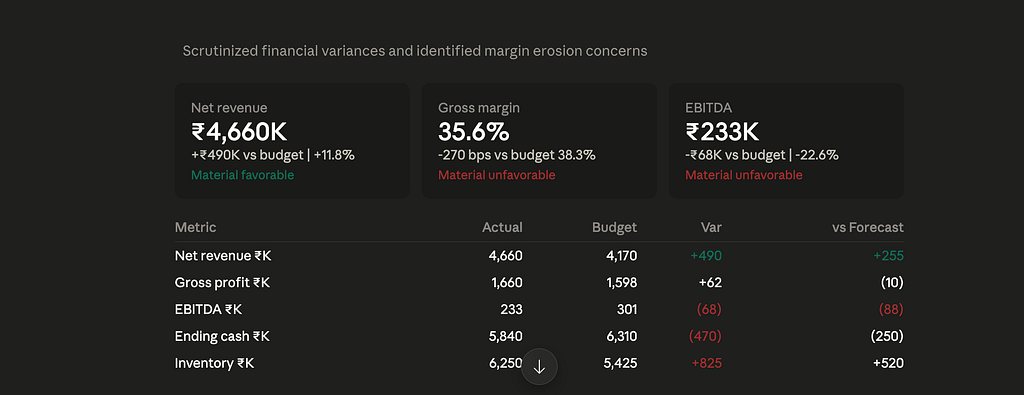
April serves as a strategic testing period for market demand, underpinned by a deliberate operational choice. While the revenue growth is genuine, leadership consciously traded higher short-term profits and liquidity for better stock availability and marketing traction during the peak spring season.
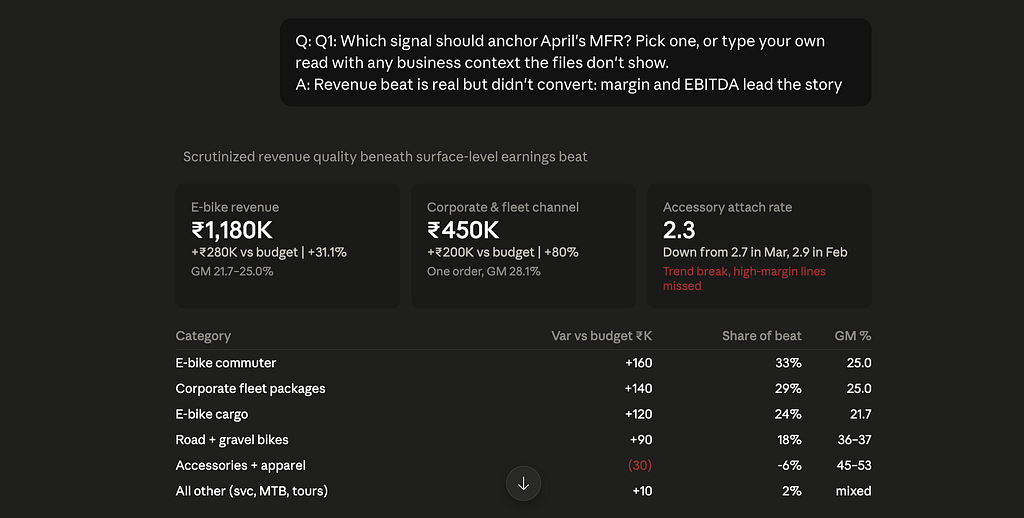
The Monthly Financial Review (MFR) should avoid labeling this performance as a failure; instead, it needs to frame May as the critical validation point. The success of this strategy now depends on showing improved margins and successful inventory reduction to prove the gamble paid off.
Claude’s analysis provides supporting evidence for the second cycle:
the revenue outperformance is genuine, sales volumes have increased, the product mix is shifting toward e-bikes, and discounting levels have remained stable without further expansion
Claude then poses the key question: how should the revenue growth be framed? It presents three alternatives and asks us to choose one.
We select Option 1: revenue growth driven by organic demand rather than pull-forward promotional activity. The data supports this interpretation, as service revenue has increased alongside bike revenue — a pattern that would be unlikely if April’s performance had been primarily fueled by promotions.
Claude records this framing decision and proceeds to the next stage of the analysis.
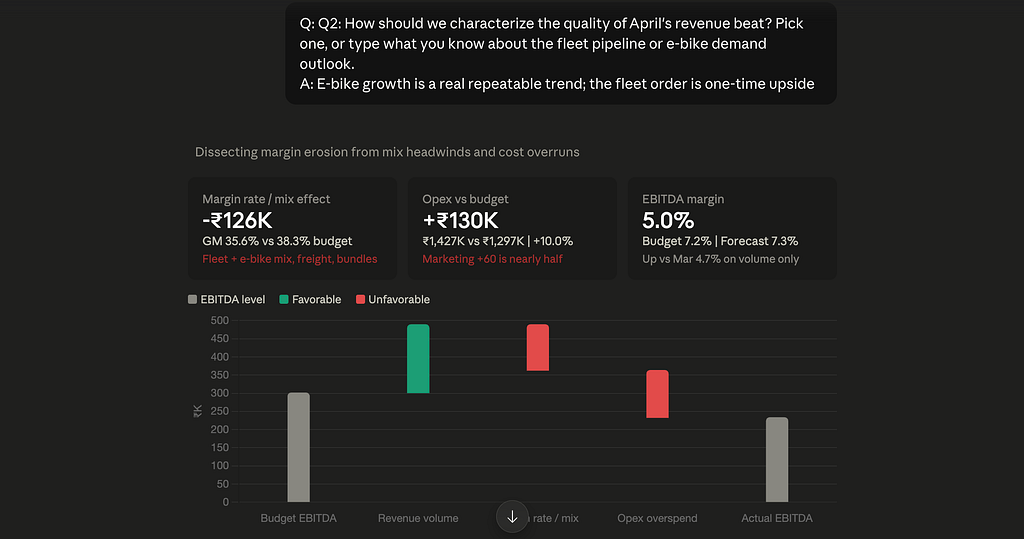
Claude summarizes the profit conversion challenge in a single view: revenue exceeded expectations, but gross margin came in below plan, resulting in an EBITDA miss. The supporting analysis highlights where margin erosion occurred and quantifies how much of the EBITDA shortfall was driven by timing-related costs versus structural changes in the product mix.
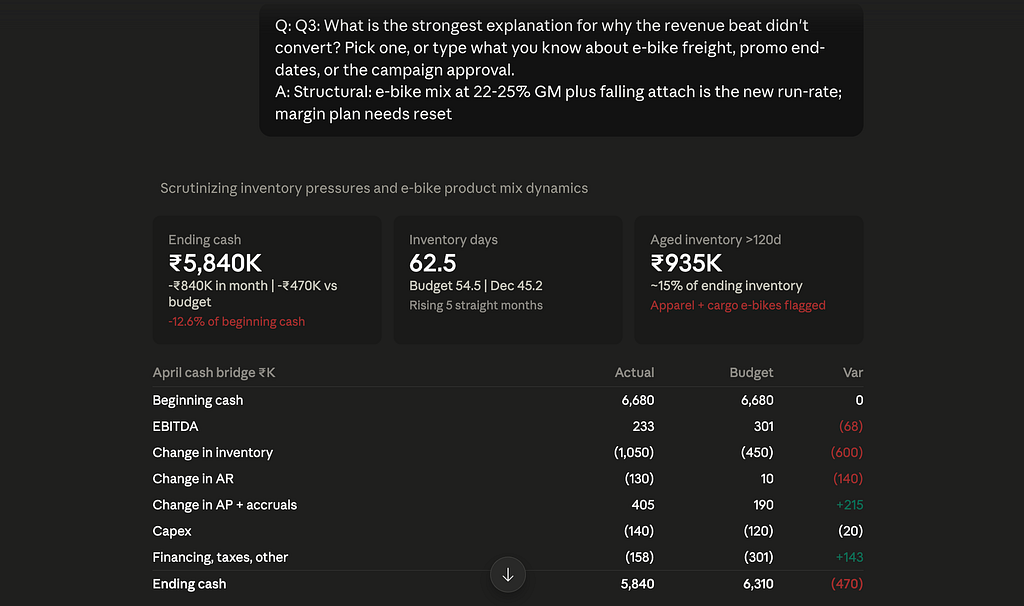
Claude then highlights the shortfall in cash conversion: operating cash flow fell behind EBITDA by a larger margin than typically seen. This discrepancy was primarily driven by working capital, as inventory was increased in anticipation of the upcoming season.
Outcome: Finally the MFR Deck
The data is presented as a corporate-styled HTML dashboard featuring cards and tables, with each screen dedicated to a single cycle. This view explicitly displays framing decisions, including the quality of revenue drivers, profit conversion metrics, and the status of cash and working capital. Additionally, the specific proof points required for May are clearly documented in writing.
This is a board-ready review, not a standard slide deck. It delivers an expert CFO-level narrative with explicit reasoning.
This is a finance reasoning workflow, not a dashboard generator.
Claude identified the month’s core contradiction — high revenue versus low profit and cash — and used guided questioning to resolve the narrative. Rather than just showing figures, the final deck explains why April validated demand, why the revenue forecast is rising, why gross margins remain steady, and what May must prove.
That is true CFO-level work.
Outcome — https://claude.ai/public/artifacts/9269d5cc-d4f8-4667-99c4-618426840033
References
Originally published on Medium.