
When We Can Finally See Inside an AI’s Mind
Published:
Why understanding how large language models think may become one of the most important breakthroughs in artificial intelligence.
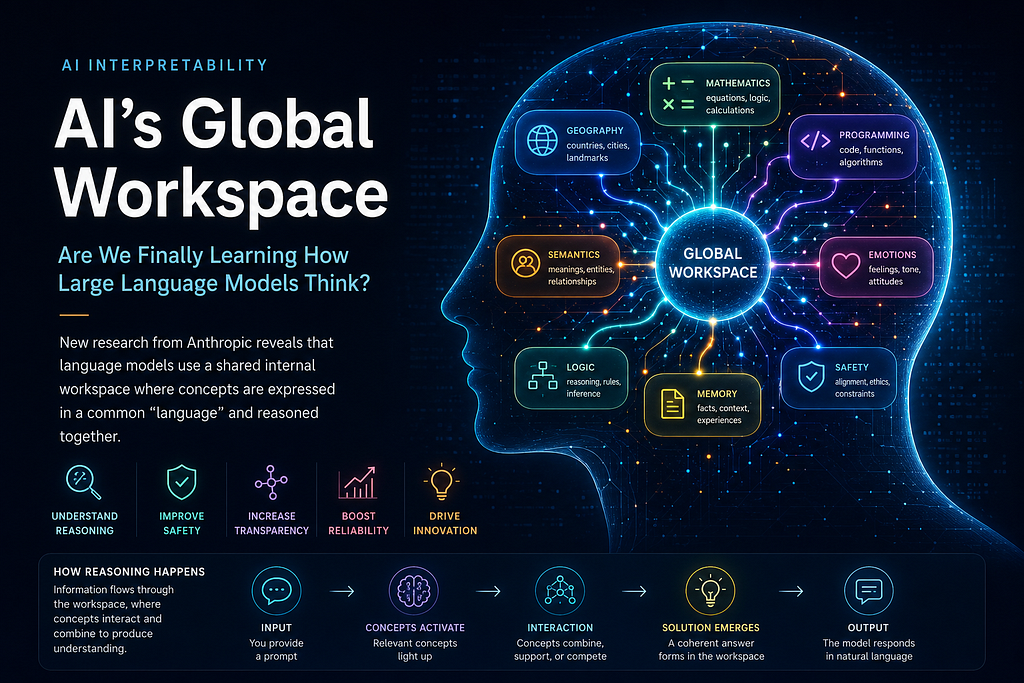
For years, one phrase has dominated discussions about artificial intelligence:
AI is a black box.
We know what goes in. We see what comes out. But what happens in between has remained largely mysterious.
When ChatGPT, Claude, or Gemini answers a question, writes code, or explains quantum physics, we observe remarkable results — but we rarely understand why a particular answer was generated.
That may be starting to change.
Recent advances in AI interpretability are giving researchers an unprecedented opportunity to peer inside large language models and observe the internal concepts they use while reasoning. Instead of treating AI as an unknowable machine, we are beginning to map its “thought process.”
This shift could become as significant for AI as the invention of the microscope was for biology.
The Myth of Next-Word Prediction
A common misconception is that language models simply predict the next word.
Technically, that is how they are trained.
But that description hides an extraordinary reality.
Imagine saying:
“The capital of France is…”
The model doesn’t merely search for the next likely word.
Instead, thousands of internal representations become active simultaneously.
Some represent:
- Geography
- European countries
- Capitals
- Previous knowledge
- Grammar
- Confidence
- Context
These internal signals interact, reinforce one another, suppress unlikely alternatives, and gradually converge on the answer:
Paris.
Prediction is only the surface. Underneath lies an incredibly rich computational process.
AI Doesn’t Memorize — It Builds Concepts
One of the most fascinating discoveries is that modern language models appear to organize information into reusable concepts rather than isolated facts.
For example, consider these words:
- Dog
- Perro
- Chien
- Hund
Although they belong to different languages, they often activate nearly the same internal concept.
The model isn’t storing separate dictionaries.
Instead, it develops an abstract understanding of what a dog is.
This explains why multilingual models transfer knowledge so effectively across languages.
The underlying idea remains the same.
Only the labels change.
A Universe of Invisible Features
Researchers often describe these internal representations as features.
Think of each feature as a tiny neuron specialized for a particular idea.
Some correspond to concrete objects:
- Mountains
- Oceans
- Cars
- Famous landmarks
Others represent abstract concepts:
- Honesty
- Humor
- Mathematics
- Programming
- Risk
- Emotion
- Financial fraud
- Medical diagnosis
Individually, these features are simple.
Collectively, millions of them create intelligence.
It’s less like searching a database and more like an orchestra, where thousands of instruments play together to produce a coherent answer.
Reasoning Is Distributed
Humans often imagine reasoning as a linear chain of thoughts.
AI doesn’t appear to work that way.
Instead, reasoning is distributed.
Thousands of concepts activate simultaneously.
Some strengthen one another.
Others suppress conflicting ideas.
The final answer emerges from this dynamic interaction.
This is one reason why language models can solve problems that were never explicitly programmed.
They are composing solutions from learned concepts rather than following fixed instructions.
Opening the Black Box
Interpretability research aims to answer a profound question:
What is happening inside the model while it thinks?
Researchers are developing techniques that identify which internal features activate for a given prompt.
For example, when solving a mathematics problem, the model may activate concepts related to:
- Numbers
- Arithmetic
- Equations
- Logical consistency
- Intermediate calculations
Instead of observing only the final answer, we can begin to inspect the reasoning process itself.
This is a major shift.
Imagine debugging software by looking only at the final screen.
Now imagine seeing every variable, every function, and every decision made during execution.
That’s the promise of interpretability.
Why This Matters for Safety
As AI becomes more capable, understanding its reasoning becomes increasingly important.
Interpretability could help us:
- Detect hallucinations before they appear in responses.
- Understand why a model produced an incorrect answer.
- Identify unsafe reasoning patterns.
- Improve transparency for regulated industries.
- Build more trustworthy AI systems.
For sectors such as healthcare, finance, education, and law, this could become essential.
It’s not enough for AI to be accurate.
We also need confidence in how it reached its conclusions.
The Parallel with Human Neuroscience
There is an interesting parallel with neuroscience.
The human brain contains roughly 86 billion neurons.
Neuroscientists have spent decades trying to understand how these neurons create thoughts, memories, and intelligence.
Large language models present a similar challenge.
They contain billions of parameters interacting in complex ways.
Interpretability research is becoming the neuroscience of artificial intelligence.
Instead of scanning brains, researchers are mapping digital neurons and the concepts they represent.
We Are Still at the Beginning
Despite impressive progress, much remains unknown.
Researchers can currently interpret only a small fraction of the internal features within today’s largest models.
Many representations remain mysterious.
Some appear to encode multiple ideas simultaneously.
Others change depending on context.
In many ways, today’s interpretability tools resemble the first telescopes or microscopes.
They provide remarkable new visibility — but the frontier is still vast.
A New Era of Explainable Intelligence
The next decade of AI may not be defined solely by larger models or faster hardware.
It may be defined by understanding intelligence itself.
When we can inspect an AI’s internal reasoning, we unlock possibilities far beyond better chatbots.
We gain the ability to:
- Build safer AI systems.
- Improve model reliability.
- Accelerate scientific discovery.
- Increase public trust.
- Create AI that can explain — not just answer.
Perhaps the greatest question in artificial intelligence is no longer “Can machines think?”
Instead, it has become:
“Can we understand how they think?”
The answer to that question may shape the future of AI as profoundly as the invention of deep learning itself.
Final Thoughts
For decades, artificial intelligence has amazed us with what it can do.
The next breakthrough will come from understanding why it works.
As the black box slowly becomes transparent, we move from simply using AI to truly understanding it.
And that understanding may prove to be the most important innovation of all.
References
- Gurnee, W., Sofroniew, N., Pearce, A., et al. “Verbalizable Representations Form a Global Workspace in Language Models.” Transformer Circuits (2026).
- Transformer Circuits Thread. Mechanistic Interpretability Research Collection.
Originally published on Medium.