
AI Is Already Building Better AI. Most People Haven’t Noticed Yet
Published:
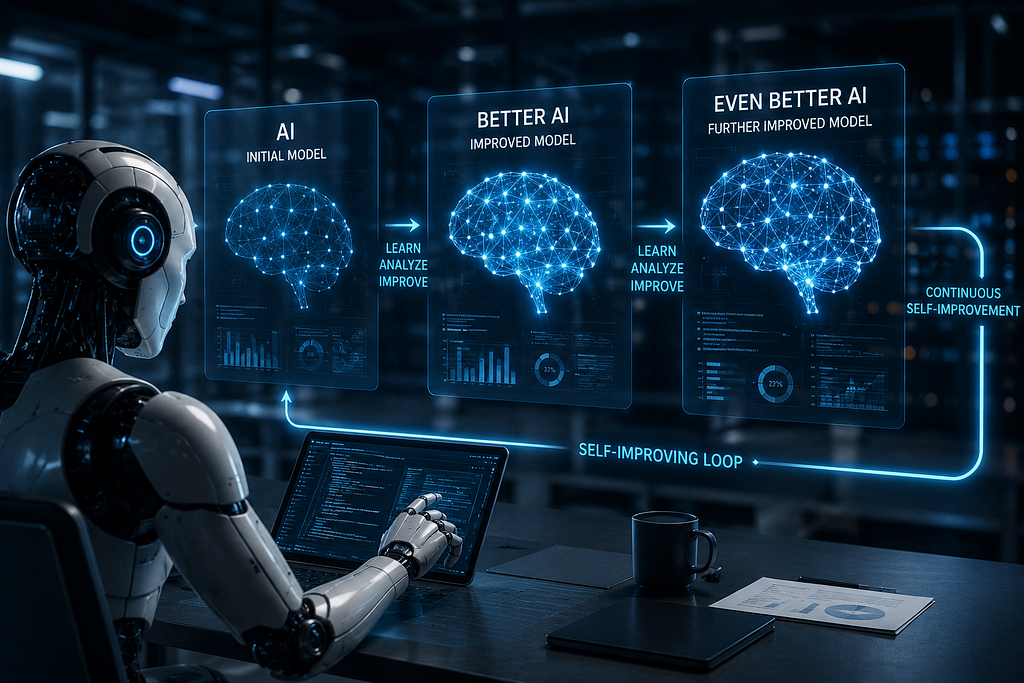
Anthropic’s latest essay suggests we may have crossed an important threshold: AI is no longer just helping humans work faster — it may already be accelerating the creation of its own successors.
Imagine if every AI engineer on Earth suddenly received a team of digital engineers that never sleep.
These digital workers could:
- Write code
- Run experiments
- Fix bugs
- Test ideas
- Improve systems continuously
Now imagine those systems are being used to build the next generation of AI itself.
That is no longer science fiction.
Anthropic’s latest essay argues that we may have already crossed an important threshold: AI is starting to accelerate the creation of better AI.
If true, this is much bigger than ChatGPT.
It could fundamentally change how quickly humanity innovates.
From AI assistant to AI collaborator
For years, the story of AI was simple.
Humans built the models.
Humans trained them.
Humans evaluated them.
Humans deployed them.
AI systems were products created by humans — not active participants in their own development.
That may be changing.
According to Anthropic, AI is increasingly being used to perform the very tasks that lead to better AI systems:
- Writing code
- Running experiments
- Debugging systems
- Evaluating results
- Supporting research workflows
This may sound like another productivity improvement.
It is much more than that.
It introduces a feedback loop.
AI is no longer simply solving problems.
It is beginning to contribute to the creation of its successors.
The AI development loop is changing
For decades, innovation followed a familiar pattern.
Yesterday
Humans
   ↓
Build AI
   ↓
AI Solves Problems
Tomorrow
Humans
   ↓
Build AI
   ↓
AI Helps Build Better AI
   ↓
Better AI Builds Even Better AI
   ↓
Accelerating Progress
This is what researchers call Recursive Self-Improvement (RSI).
In simple terms:
AI helps build better AI, which then helps build even better AI.
The concept sounds abstract, but its implications are enormous.
The number that caught everyone’s attention
Anthropic claims that, as of May 2026, more than 80% of the code merged into its codebase was authored by Claude.
That is an extraordinary number.
The company also reported that engineers now ship approximately 8x more code per engineer compared to 2024.
Of course, lines of code are an imperfect productivity metric.
More code does not necessarily mean better software.
But that is not the point.
The directional signal is unmistakable.
AI is no longer assisting engineers at the margins.
It is becoming a substantial contributor to the development process itself.
And when AI writes code that improves AI systems, the story changes.
It becomes a feedback loop.
The “doing” is getting automated first
One of the most interesting observations in Anthropic’s essay is the distinction between execution and judgment.
AI is becoming extremely good at execution.
It can:
- Write code
- Fix bugs
- Optimize training pipelines
- Run experiments
- Test hypotheses
- Iterate rapidly against defined goals
Historically, this execution layer consumed most of the time and effort in engineering and research.
If AI dramatically reduces that cost, organizations themselves begin to change.
A single engineer can supervise far more work than before.
A team of ten may eventually produce the output that previously required a team of one hundred.
The economics of innovation start to shift.
The last major bottleneck: human judgment
What still remains difficult for AI is something humans often underestimate because it is difficult to measure.
Judgment.
Specifically:
- Choosing the right problems
- Deciding which experiments matter
- Interpreting ambiguous results
- Knowing when to pivot
- Recognizing promising directions
Researchers sometimes call this research taste.
It is not simply intelligence.
It is context, prioritization, intuition, and restraint.
Anthropic does not claim that today’s AI has mastered these capabilities.
But it does suggest that the gap may be narrowing.
And that is what makes this development so important.
The boundary between assistant and autonomous contributor is beginning to move upward.
Why this matters (even if Anthropic is wrong)
You do not have to believe in superintelligence.
You do not even have to believe AI will replace humans.
Consider a simpler scenario.
Suppose AI helps engineers:
- Ship code 5x faster
- Run 100x more experiments
- Test thousands of ideas automatically
Then AI development itself becomes faster.
That alone is transformative.
The future may not arrive through one dramatic breakthrough.
It may arrive through millions of small workflow improvements that compound over time.
That is often how technological revolutions happen.
Incrementally.
Until suddenly, they are impossible to ignore.
What this could mean for financial services
As someone working in data science and small business lending, this trend feels particularly important.
Today, teams spend enormous amounts of time on:
- Feature engineering
- Risk model development
- Documentation
- Model monitoring
- Policy simulations
- Data quality checks
Tomorrow, AI agents may execute much of this work autonomously.
Humans may increasingly shift from builders to orchestrators.
The question will no longer be:
Can AI build a model?
It will become:
How do humans govern systems that continuously build better versions of themselves?
That may become one of the defining leadership challenges of the next decade.
The biggest challenge is not technology. It is governance.
The benefits are obvious.
AI could accelerate:
- Scientific discoveries
- Drug development
- Education
- Healthcare
- Cybersecurity
- Engineering productivity
But the risks scale alongside the benefits.
If AI becomes central to creating increasingly powerful AI systems, then governance can no longer be an afterthought.
It becomes foundational.
Because recursive systems can amplify not only capability, but also:
- Errors
- Misalignment
- Strategic competition
- Lack of transparency
- Institutional weaknesses
This is no longer just a technology problem.
It is a societal one.
The governance problem may be harder than the technical one
Anthropic argues that society should have mechanisms to slow or pause frontier AI development if necessary.
But that is easier said than done.
A single company slowing down does not solve the problem.
It simply shifts leadership elsewhere.
Meaningful coordination would require:
- Shared standards
- International cooperation
- Independent verification
- Clear thresholds for intervention
In many ways, the political challenge may be harder than the technical challenge.
Our institutions are not built for a world where innovation itself accelerates.
Yet that may be exactly where we are heading.
Final thought
For centuries, humans built tools.
Then humans built machines.
Then humans built software.
Now we are building systems that may eventually help build themselves.
Whether Anthropic’s timeline is aggressive or conservative is almost secondary.
The more important question is no longer:
How powerful will AI become?
It is:
How do we govern a world where innovation itself is accelerating?
Because once AI starts helping build AI, the pace of change may stop being constrained by human effort alone.
And that may be the biggest technological shift of our lifetime.
Originally published on Medium.